WENDY'S INTERNATIONAL

Our Challenge
Wendy's engaged us to create a Point of Sale system which would:
- Support conversational ordering
- Increase accuracy and speed
- Allow for significant growth in menu offerings
Our Research
We conducted field studies in various markets and store types, learning about employees' struggles, frustrations, and the unique context in which they work.
We brought back some surprising findings regarding customer interaction, employees' use of technology (and ways they got around its limitations). We also provided insights which helped corporate adjust the way they monitored and communicated with employees.Our Design
We analyzed customer orders we had collected in the field, and created a design based on this and a host of other data. Thus, our design was founded not only on solid usability principles, but also on hard data specific to the Wendy's environment.
The new design allows cashiers to:
- Take an order as the customer speaks it with less translation and fewer interruptions.
- Easily make adjustments when the customer changes his/her mind.
- Assess order accuracy at the point of interaction, rather than having to continually check the virtual receipt.
- Quickly find needed menu items and functions, due to an organization and flow that matches the way they think.
Our Results
The new design has produced a 90% reduction in voids while increasing speed of service, order accuracy, customer satisfaction, and average check size.
STARBUCKS COFFEE COMPANY


The Situation
Starbucks is a Fortune 500 company with over 15,000 stores in 44 countries. They currently use various outdated POS solutions, and they engaged Scoresby Interactive to create a single, highly-usable solution extensible to all stores worldwide.
The Approach
After establishing Starbucks' goals and success criteria, we began by visiting a representative mix of stores across the U.S. and U.K. As in the Wendy's studies, employees were videotaped and customer orders were captured for later analysis.
Through our observations and interviews, we discovered a plethora of immediate and potential fixes to Starbucks' processes and technology. We also discovered many sources of error, including numerous points of "translation" where problems were more likely to happen.
We iteratively created a Point of Sale design that meets Starbucks' goals, fits into employees' processes, and solves the problems we discovered in the field. Then, we tested it with Starbucks employees to further refine the design.
The Response
Presentations in various venues—including a New Orleans Conference for Starbucks Managers—have generated tremendous excitement and anticipation, with numerous managers requesting that the system be piloted in their store.
The system is now in several stores, and results indicate that the new POS design successfully:
- Accepts customers' various ways of ordering rather than requiring a specific flow.
- Reduces the burden on new employees who are still learning recipes.
- Facilitates employee training by communicating the default ingredients of each ordered drink.
- Allows most cashiers to begin taking orders with a simple 3-minute orientation.
Savings in training costs alone are expected to exceed our project fees hundreds of times over.
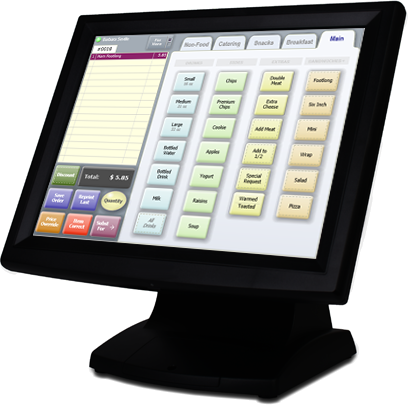
SUBWAY RESTAURANTS

Preparation
On recommendation from Wendy's and Starbucks, Subway's purchasing arm, IPC, hired Scoresby Interactive to create a best-of-breed POS solution. As with the other projects described here, we began by identifying Subway's goals for the new Point of Sale system, which included:
- Reducing training time
- Reducing employee theft
- Improving accuracy
- Increasing speed of service
Field Studies
We visited a wide variety of store types throughout the United States and Canada, watching employees work , interviewing them, and gaining understanding of their problems, processes, and concerns.
In addition to learning how to achieve the original four goals, we also added another goal to the list as a result of the Field Studies: We determined that, to the extent possible, the Point of Sale design should also help improve some of the inventory issues we observed.
Design and Evaluation
Armed with the knowledge from research, we iteratively designed Subway's new cashiering system and created a prototype of the design. We then took the prototype to Subway's Las Vegas convention and evaluated it with about 350 visitors.
The response was tremendous, though we learned some things that allowed us to tweak the original design to make it even better.
Preliminary Successes
We have just started a series of laboratory store tests with tremendous results thus far, such as:
- After seeing how easy the design is to learn, store managers canceled the scheduled training, instead giving employees a simple orientation as they began their shift.
- The new system allows noticeably more eye contact and friendly conversation with the customer.
- Employees describe the new system as "fun" and report that it takes very little effort to learn and use.

Contact Us
News
Home